# Quickstart

### Overview

![](https://files.readme.io/269d611-Screenshot_2024-02-02_at_11.17.47_AM.png)

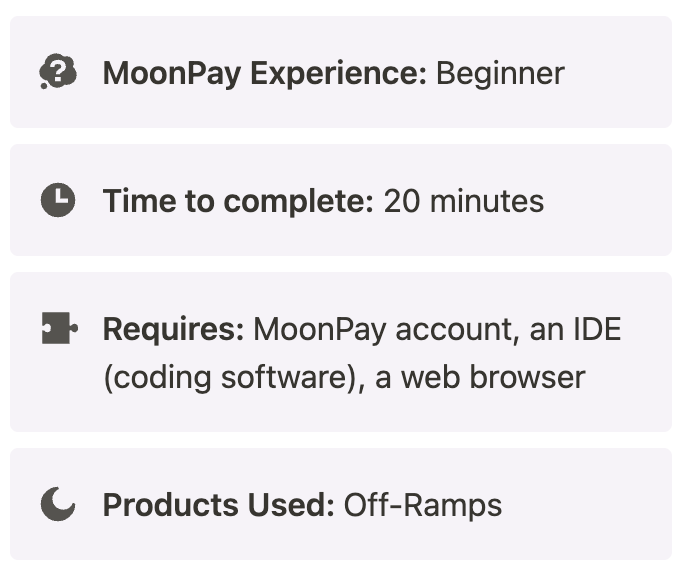
In this Quickstart, you will facilitate the sale of cryptocurrency via the MoonPay Off-Ramp, directly from your browser.

Whether you are a complete beginner to coding or a seasoned expert, this guide will take you through all of the necessary steps to have you converting cryptocurrency to fiat in no time.

***

### What you will accomplish

In this tutorial, you will:

* Configure Off-Ramps widget in a local environment
  * Create a new folder for the implementation
  * Initialize the widget in a file using HTML and JavaScript
  * Edit the widget parameters
  * Display the fully functional widget locally in your browser

***

### Prerequisites

Before beginning, you will need:

* **A MoonPay account**: If you do not have one, set one up through our team on [this page](https://dashboard.moonpay.com/signup).
* **An IDE (coding software):** Some popular ones are [Visual Studio](https://visualstudio.microsoft.com/downloads/), [IntelliJ IDEA](https://www.jetbrains.com/idea/), and [Eclipse](https://eclipseide.org/). We will be using Visual Studio in this tutorial.
* **A web browser:** Any web browser will work. We will be using Google Chrome in this tutorial.

***

### Implementation

#### Step 1: Set up a file for your integration
![](https://files.readme.io/4b87dbc-Screenshot_2023-11-06_at_4.01.57_PM.png)

#### Step 2: Retrieve API keys from the MoonPay Dashboard

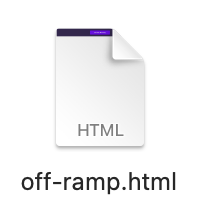
In your IDE, create a new file for your Off-Ramp code. Ours will be called off-ramp.html.

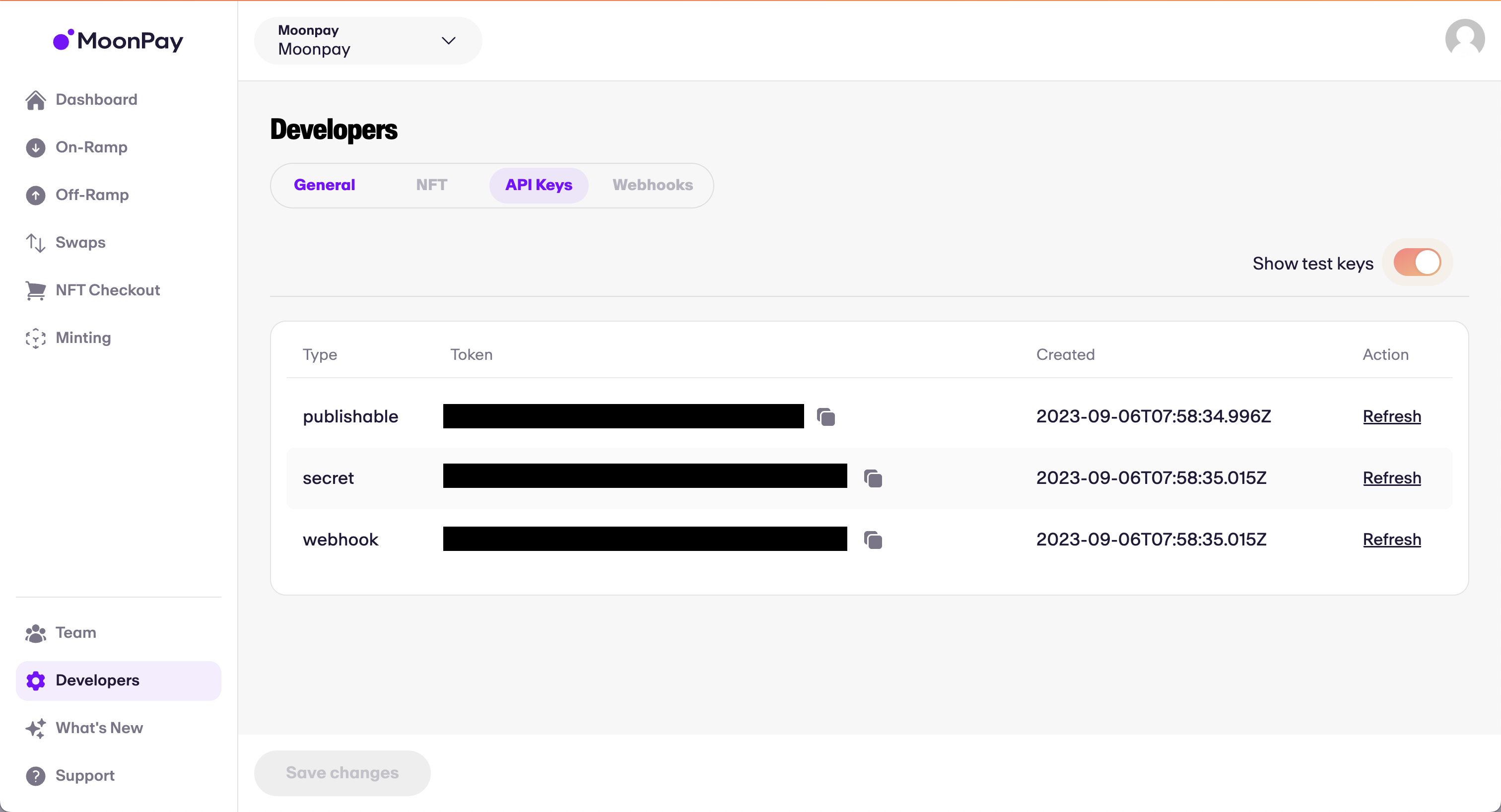
* Navigate to your [MoonPay Dashboard](https://dashboard.moonpay.com/) and log in.
* Once logged in, navigate to the Developers tab on the sidebar → API Keys.
  * Here, you will be able to copy your API keys. In this tutorial, we will be using the publishable test key.
![](https://files.readme.io/d744891-Screenshot_2023-10-27_at_2.09.05_PM.png)

#### Step 3: Insert HTML and code into off-ramp.html

* The code below will embed our Software Development Kit (SDK) directly into your HTML by way of `<script>` tags.

  * You can think of this as a way of injecting code directly into HTML without having to create a separate linked file

  HTML

  ```html
  <!DOCTYPE html>
  <html lang="en">
  <head>
      <meta charset="UTF-8">
      <meta name="viewport" content="width=device-width, initial-scale=1.0">
      <title>MoonPay Integration</title>

      <!-- Adds the MoonPay SDK as a script to your HTML file -->
      <script defer src="https://static.moonpay.com/web-sdk/v1/moonpay-web-sdk.min.js"></script>

      <!-- Initialize the MoonPay SDK immediately upon page load -->
      <script>
          document.addEventListener("DOMContentLoaded", () => {
              const moonpaySdk = window.MoonPayWebSdk.init({
                  flow: "sell",
                  environment: "sandbox",
                  variant: "overlay",
                  params: {
                      apiKey: "pk_test", // Replace with your MoonPay publishable test API key
                      baseCurrencyCode: "eth",
                      baseCurrencyAmount: ".15",
                      defaultBaseCurrencyCode: "eth",
  										quoteCurrencyCode: "usd"
                  }});

              // Open widget
              moonpaySdk.show();
          });
      </script>
  </head>
  <body>
      <div class="container">
      </div>
  </body>
  </html>
  ```
* This script will detect when the HTML page loads and immediately run the JavaScript within the `<script>` tags when the load has finished. Remember to replace `pk_test` with your publishable test API key from **Step 1**.
* You can customize widget functionality (currencies, amounts, etc.) by adding and removing parameters in the JavaScript, whilst still preserving proper formatting.
  * All parameters can be found on [this page of our documentation](https://moonpay.readme.io/docs/off-ramp-how-to-configure-user-journey-params).
* For example, if we would like to display the widget with a default of selling *.05 BTC to EUR*, and set `lockAmount` to `true` in the parameters so that the user cannot modify the sell amount, we could modify the JavaScript like such:

HTML

```html
    <script>
        document.addEventListener("DOMContentLoaded", () => {
            const moonpaySdk = window.MoonPayWebSdk.init({
                flow: "sell",
                environment: "sandbox",
                variant: "overlay",
                params: {
                    apiKey: "pk_test", // Replace with your MoonPay publishable test API key
                    baseCurrencyCode: "btc",
                    baseCurrencyAmount: ".05",
                    defaultBaseCurrencyCode: "btc",
										quoteCurrencyCode: "eur",
										lockAmount:"true"
                }});

            // Open widget
            moonpaySdk.show();
        });
    </script>
```

#### Step 4: Do a test transaction

* The first step of processing a test transaction using the MoonPay Off-Ramp is to make sure that `environment` is set to`"sandbox"`, as shown above in the example code. This puts your widget in test mode.
* Next, open up the widget, enter your email address, and log in.

![](https://files.readme.io/013fb3f-Screenshot_2023-10-27_at_5.57.08_PM.png)

* You will be prompted to configure your Sell transaction, eventually arriving at the below screen. Click on “View deposit details”.

![](https://files.readme.io/e123fcf-Screenshot_2023-11-08_at_3.59.16_PM.png)

* You will now see the below screen, prompting you to send the previously specified amount of cryptocurrency to a wallet on the corresponding blockchain. Click the “I’ve sent my crypto” button.

![](https://files.readme.io/e666794-Screenshot_2023-11-08_at_4.01.33_PM.png)

* When successful, you will see green checks on the Pending, Processing, and Sent pages! ✅

***

### Completion

Congratulations, you have just integrated the MoonPay Off-Ramp 🎉

Any questions? Feel free to visit our [Help Center](https://support.moonpay.com/hc/en-gb/categories/360001595097-Customer-Support-Help-Center) to dig into our other resources or drop us a line!